The Grange
Why Didn't They Ask EvansThe Grange is Dr Jasper Nicholson’s secluded treatment establishment, ostensibly a place for people with nervous conditions and drug dependence. Its clinical purpose is repeatedly shadowed by the possibility of confinement and criminal control: behind its walls, a proposed cure for Henry Bassington-ffrench becomes part of a plan to remove him, while Moira Nicholson’s fear of her husband is given a setting that makes escape and safety uncertain.
Identity and Medical Purpose
The Grange stands on the far side of the village from Merroway Court, about three miles from the Bassington-ffrench home. Roger describes it to Frankie as a nearby place where Henry might be treated for his morphia use. He says Henry likes Dr Nicholson and suggests that a period of remorse might make Henry willing to accept treatment. The prospect is framed as a cure that could be kept from Sylvia Bassington-ffrench: if it succeeded, Roger believes, Henry’s dependence need not become a subject of his wife’s knowledge.
The treatment is not presented as gentle or uncomplicated. At dinner, Sylvia acknowledges that Dr Nicholson has reportedly cured drug takers whom their families had given up on. Henry responds with a distressed description of withdrawal as severe torment, insisting that the doctor’s method can drive patients into extreme suffering. His reaction does not establish that his account is a fair description of every treatment at The Grange, but it makes the institution’s reputation for success inseparable from the cost of treatment and from Henry’s own dependence.
Walls, Rumour, and Reputation
To villagers, The Grange is a troubling newcomer’s establishment rather than an ordinary family home. A local account says it had stood empty for years before a doctor took it, and alleges that some people there have been placed by relatives against their will. The same speaker reports cries and groans, while conceding that the doctor’s authority and the stated treatment of nervous cases make the institution appear legitimate. These are neighbourhood claims, not independently verified findings; their importance lies in the suspicion they attach to a place whose work is difficult for outsiders to observe.
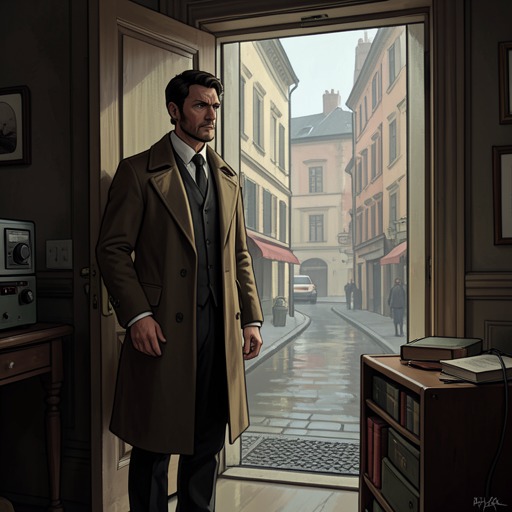
Bobby weighs that suspicion against the prejudice villages may direct at newcomers. He can imagine that a facility treating people dependent on drugs might produce disturbing sounds without any sinister cause. But the account of a girl trying to get away troubles him enough to consider whether genuine patients might provide cover for people held there unwillingly. The uncertainty does not dissolve when he reaches the property: he finds a high wall and locked wrought-iron gates, and the enclosure gives the place the appearance of a prison. The physical boundary turns village gossip into a question about who can enter, who can leave, and whose account of life inside will be believed.
Moira and Bobby’s Night-time Encounter
Bobby’s decision to approach the grounds brings him into contact with a frightened young woman. On a moonlit night, after finding a way into the enclosed grounds, he sees her come around the house, moving cautiously and then stopping as if she might collapse. He catches her and tries to reassure her. The encounter transforms The Grange from a subject of rumour into a setting for a particular person’s fear.
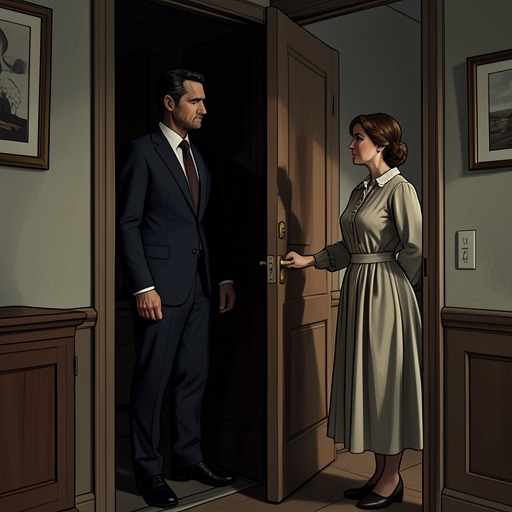
Bobby later recognizes the woman as the original of the photograph that had mysteriously disappeared. When she identifies herself as Moira Nicholson, she makes clear that she is Dr Nicholson’s wife, not a patient at the establishment. She tells Bobby that she believes her husband intends to kill her and describes incidents she interprets as deliberate attempts on her life, including a car manoeuvre and a substance placed in the wrong bottle. Her claims remain her account, but their setting matters: she is speaking from within the household and institution associated with the man she fears, not as one of the patients about whom village stories circulate.
Moira also connects her danger to the Bassington-ffrench household. She believes Dr Nicholson wants to marry Sylvia and is arranging for Henry to be brought to The Grange as a patient. She suspects that Dr Nicholson supplies Henry with morphia, which Henry receives by post, and fears that something will happen once Henry is under the doctor’s care. Her explanation joins the institution’s medical role to the drug dependence Roger had privately discussed with Frankie. The Grange is thus implicated in a threatened chain of events, although Moira admits she does not know precisely what is planned.
The Grange in the Criminal Scheme
Roger’s later account confirms that the danger attached to Henry’s proposed treatment was not merely Moira’s suspicion. Roger says he introduced Henry to morphia and intended for Henry to enter The Grange for treatment, where he might either appear to commit suicide or obtain an overdose. In Roger’s plan, Moira would carry out the killing, leaving Roger himself apparently unconnected. The language of treatment supplies a plausible route into the institution; the expected dependence on morphia supplies the means to disguise murder as a consequence of Henry’s condition.
This revelation sharpens the contrast between The Grange’s public identity and its criminal use. Its work with drug-dependent patients can make distress and confinement seem medically explicable, while the same setting offers Roger an opportunity to hide a death within the appearance of treatment or suicide. The novel does not make every rumour about the institution true. Instead, it shows how the authority of a doctor and the opacity of a closed establishment can be exploited to make a real crime harder to distinguish from medical misfortune.
Narrative Role and Later Return
The Grange first gathers significance through descriptions given at a distance: Roger presents it as a possible cure, Sylvia describes its doctor’s reputation, and villagers portray it as a place of unexplained suffering. Bobby’s night-time approach tests those stories against the locked boundary and his meeting with Moira. Later, Frankie and Bobby travel there together; Frankie has not visited before and finds the iron gates and overgrown shrubbery dispiriting. In a subsequent search of the rooms, they find Moira lying on a bed, apparently unconscious but still breathing. The scene establishes her vulnerable condition without, in the available account, explaining how she came to be there.
The setting’s recurring force comes from the gap between its declared purpose and the uncertainty surrounding the people inside. Treatment, dependence, rumour, and restricted movement converge at The Grange, but the evidence does not reduce it to a simple symbol or establish that every patient is unlawfully confined. Its role is more specific: it is the place where a proposed cure can be made to conceal a killing, where Moira’s fear becomes a direct appeal for help, and where the novel tests the credibility of explanations offered by those who hold medical and domestic power.